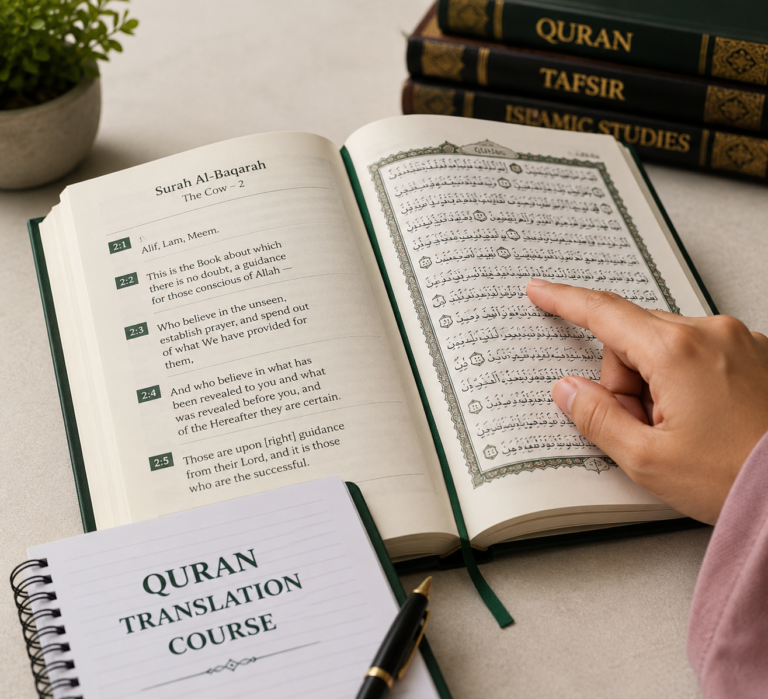
Quran Translation Course
Learn to Understand the Quran, Not Just Recite It
Do you read the Quran but struggle to understand its meaning? Have you memorized Surahs yet still depend on translations to understand what Allah is saying? Our Quran Translation Course is designed to bridge the gap between recitation and understanding through a structured pathway that combines Quranic Arabic, vocabulary, grammar, morphology, Tafsir foundations, and authentic scholarly guidance.
This course helps students move beyond reading Arabic text toward understanding Quranic meanings, contexts, messages, and practical applications. Through live online classes with qualified teachers, students learn how Quranic words, sentence structures, and linguistic patterns work together to convey divine guidance.
Whether you are a beginner, a practicing Muslim seeking deeper understanding, a parent looking for meaningful Quran education for your child, or a student of Islamic studies, this program provides a systematic framework for Quran comprehension.
Why Many Muslims Struggle to Understand the Quran
Millions of Muslims recite the Quran every day, yet many feel disconnected from its meanings. The challenge is not recitation itself but understanding the language, context, and message of the Quran.Many learners face common difficulties:
- Reading Arabic without understanding meanings
- Memorizing Surahs without comprehending their message
- Confusion between translation and Tafsir
- Difficulty choosing authentic translations
- Lack of structured Quranic Arabic education
- Limited access to qualified teachers
Translation alone is often insufficient because Quranic meanings are connected to Arabic grammar, morphology, vocabulary, context of revelation, and scholarly interpretation.Understanding the Quran requires more than translating words. It requires learning how Quranic language communicates guidance, law, ethics, worship, history, and spiritual development.This is why our Quran Translation Course combines translation with Quranic Arabic, Tafsir foundations, vocabulary development, grammar study, and contextual understanding.
What Is a Quran Translation Course?
A Quran Translation Course is a structured educational program that teaches students how to understand the meanings of Quranic verses through language study, translation methodology, and authentic interpretation.
Students learn:
- Quranic vocabulary
- Arabic root words
- Quranic grammar (Nahw)
- Arabic morphology (Sarf)
- Sentence analysis
- Word-by-word translation
- Contextual translation
- Tafsir foundations
- Surah understanding
The objective is not merely to read translations but to develop the ability to understand how Quranic meanings are derived and explained.
Quranic Arabic Foundation
Quranic Arabic is the language foundation of Quran understanding.Students begin by learning:
- Common Quranic vocabulary
- Frequently occurring Quranic words
- Arabic root systems
- Word patterns
- Sentence structures
- Basic Arabic semantics
This foundation allows learners to recognize recurring vocabulary throughout the Quran and understand how meanings are formed.As vocabulary expands, students begin understanding larger portions of verses without depending entirely on external translations.
Grammar and Morphology
Understanding Quranic Arabic requires studying the linguistic framework of the language.
Students learn:
- Nahw (Grammar)
- Sentence structure
- Subject and predicate
- Verb constructions
- Grammatical relationships
- Sarf (Morphology)
- Root letters
- Word patterns
- Verb forms
- Derivative meanings
These disciplines help students understand why certain words appear in specific forms and how grammatical changes affect meaning.
This creates a stronger foundation for accurate Quran translation and interpretation.
Quran Vocabulary Development
Vocabulary is one of the most important components of Quran understanding.
Students systematically study:
- High-frequency Quranic vocabulary
- Quranic expressions
- Repeated Quranic phrases
- Thematic vocabulary
- Worship-related terminology
- Ethical and legal terminology
By mastering common Quranic vocabulary, students can recognize meanings across multiple Surahs and develop reading confidence.
Translation Methodology
Translation is more than replacing Arabic words with English or Urdu equivalents.
Students learn:
Word-by-Word Translation
Understanding the direct meaning of individual words.
Phrase Translation
Learning how words function together in context.
Contextual Translation
Understanding intended meanings within the broader message of the verse.
Comparative Translation
Studying differences between respected translations and understanding why translators may choose different wording.
This methodology helps students appreciate both the precision and limitations of translation.
Tafsir Foundations
Translation and Tafsir are related but not identical.
Translation explains the apparent meaning of words.
Tafsir explains:
- Context of revelation
- Historical background
- Scholarly interpretation
- Connections between verses
- Practical lessons
Students are introduced to authentic Tafsir methodologies and classical scholarly approaches that support deeper understanding.
This prevents misunderstandings and provides context that translation alone cannot provide.
Authenticity and Scholarly Guidance
Authentic Quran understanding requires reliable sources and qualified teachers.
Our teaching approach is built upon:
- Quran and Sunnah
- Classical Islamic scholarship
- Quranic Arabic studies
- Recognized Tafsir methodologies
- Structured educational progression
Students learn from qualified teachers who guide them through the linguistic and contextual dimensions of Quran understanding.
Authenticity remains central throughout the learning process.
Who This Course Is For
New Muslims (Reverts)
Build a strong foundation in Quran understanding through beginner-friendly instruction and guided learning.
Practicing Muslims
Move beyond recitation and strengthen your relationship with the Quran through meaningful understanding.
Parents
Help children understand the meanings behind what they recite and memorize.
Students of Islamic Studies
Develop a deeper understanding of Quranic language, Tafsir, and translation methodology.
Busy Professionals
Learn through flexible online classes designed around modern schedules.
Online Quran Learning Experience
Students can learn from anywhere through live online classes.
Features include:
- One-to-one sessions
- Male and female teachers
- Flexible scheduling
- Interactive lessons
- Structured curriculum
- Progress tracking
- Regular assessments
The online learning environment makes Quran education accessible regardless of location.
Relationship Between Translation, Tajweed, and Memorization
Quran learning becomes more meaningful when recitation is combined with understanding.
Students often study:
- Tajweed for correct recitation
- Memorization for retention
- Translation for understanding
- Tafsir for context
Together these disciplines create a comprehensive Quran learning experience.
Recitation improves pronunciation.
Memorization strengthens retention.
Translation develops understanding.
Tafsir provides depth and context.
Learning Outcomes
By completing the course, students can:
- Understand common Quranic vocabulary
- Recognize frequently occurring Quranic words
- Understand basic Quranic grammar
- Analyze verse structures
- Translate selected Quranic passages
- Understand Surah themes
- Distinguish translation from Tafsir
- Continue advanced Quran studies with confidence
Students gain the tools necessary to engage with the Quran more deeply and develop a stronger connection with its message.
Begin Your Quran Understanding Journey
The Quran was revealed as guidance for humanity. Understanding its message brings greater clarity, reflection, and connection to Allah’s words.
Our Quran Translation Course provides a structured pathway from recitation to understanding through Quranic Arabic, vocabulary, grammar, translation methodology, Tafsir foundations, and authentic scholarly guidance.
Start your journey toward understanding the Quran with confidence, clarity, and purpose.